Build vs. Buy Code Intelligence: The Real ROI
Building in-house code graphs costs $250k+ and 6 months. Adopting Coograph cuts AI spend 80% while freeing engineers to ship product.
Your VP of Engineering just asked: “Should we build our own code intelligence system, or adopt something off the shelf?”
Two weeks later, you’re still debating. The build team says they can “do it faster and cheaper.” The pragmatists point to the $30k/month OpenAI bill. Nobody has a number for what building actually costs.
Here’s the math: a production-ready code intelligence system takes 6–9 engineer-months to build, costs $250k+ in salary alone, and then never stops consuming engineering time. Meanwhile, your AI agent is burning tokens on irrelevant code context, ballooning your LLM API bill. This post walks through the real ROI of the buy decision—and when building actually makes sense.
The Hidden Costs of ‘Free’ In-House Code Intelligence
Every founder thinks they can build infrastructure faster than the market. Some can. Most can’t, and the code intelligence space has no margin for error.
Calculating the Engineer-Months to Build
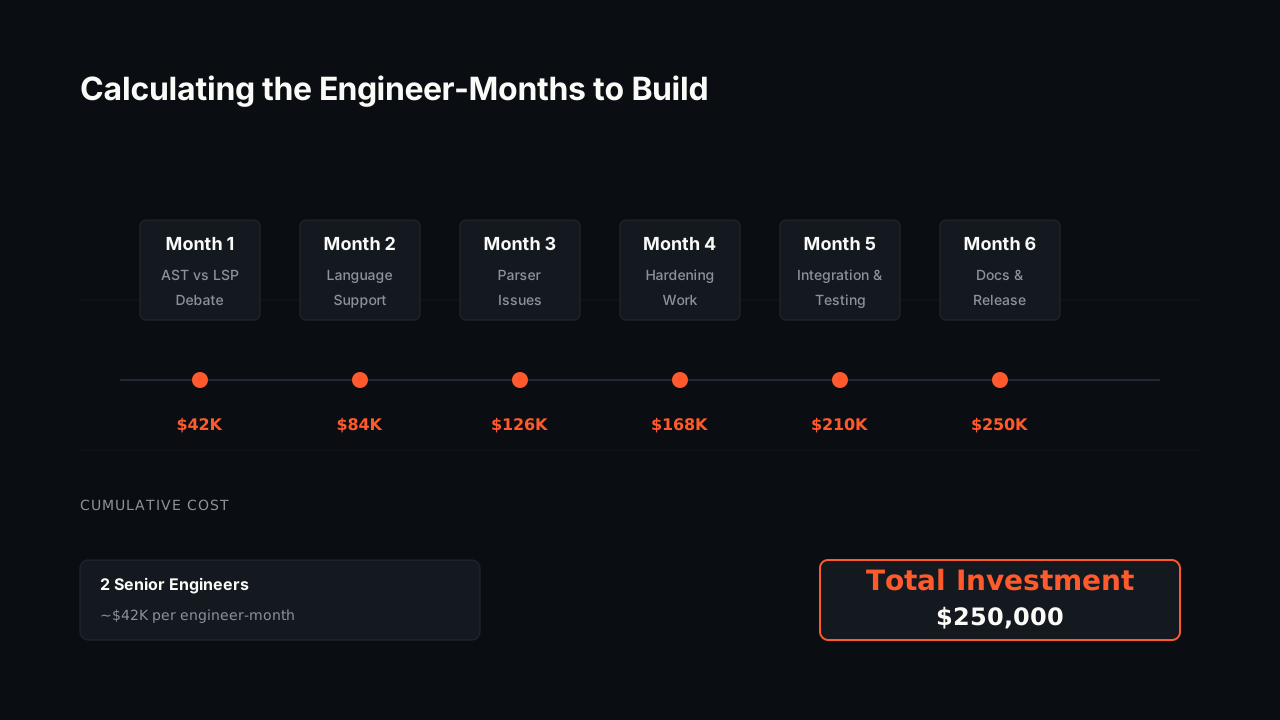
Take two senior engineers at your company. Their fully-loaded cost is roughly $200k/year each. You task them with building a system that parses your codebase, creates semantic relationships between files and functions, tracks imports across modules, and surfaces this data to an AI agent in real-time.
In month one, they argue about AST vs. LSP strategies. Month two, they realize they need to handle 14 languages, not three. Month three, they discover that your test files break their parser logic. By month six, they’ve shipped something that works 85% of the time on your specific codebase.
That’s $200k in direct salary for a system that still needs another 3 months of hardening. When you factor in infrastructure, CI/CD pipelines, and the time spent debugging edge cases, you’re looking at $250k+ before the first external engineer uses it.
Now multiply that by maintenance: every new framework your company adopts, every language a new team wants to use, every edge case discovered in production. You’re permanently staffing this project.
The Long-Term Maintenance Tax
Code intelligence isn’t a build-once problem. When your team starts using Async/Await patterns that your parser doesn’t understand, someone needs to fix it. When you adopt a monorepo and your graph breaks, an engineer is paged. When you switch from CommonJS to ESM, the system needs an update.
This isn’t theory. We’ve talked to teams who shipped their own graph system 18 months ago and now dedicate half an engineer to keeping it from rotting. That’s $100k/year in hidden tax, indefinitely.
Opportunity Cost: What Aren’t Your Engineers Building?
The real cost isn’t the salary; it’s the product you’re not shipping. If those two engineers spent the next 9 months on your core product instead of infrastructure, what could they ship? A feature that drives $500k/year in revenue? A performance optimization that cuts your cloud bill by 20%?
When you frame it that way—two engineers for nine months is not “let’s build it faster,” it’s a $250k bet that your custom system beats what a specialized team has already solved—the decision becomes clearer.
Hard Savings: Quantifying the Reduction in AI Spend
The buy argument gets real when you look at the AI bill. Most teams use code intelligence poorly because they don’t have it at all.
An 80% Drop in Token Consumption
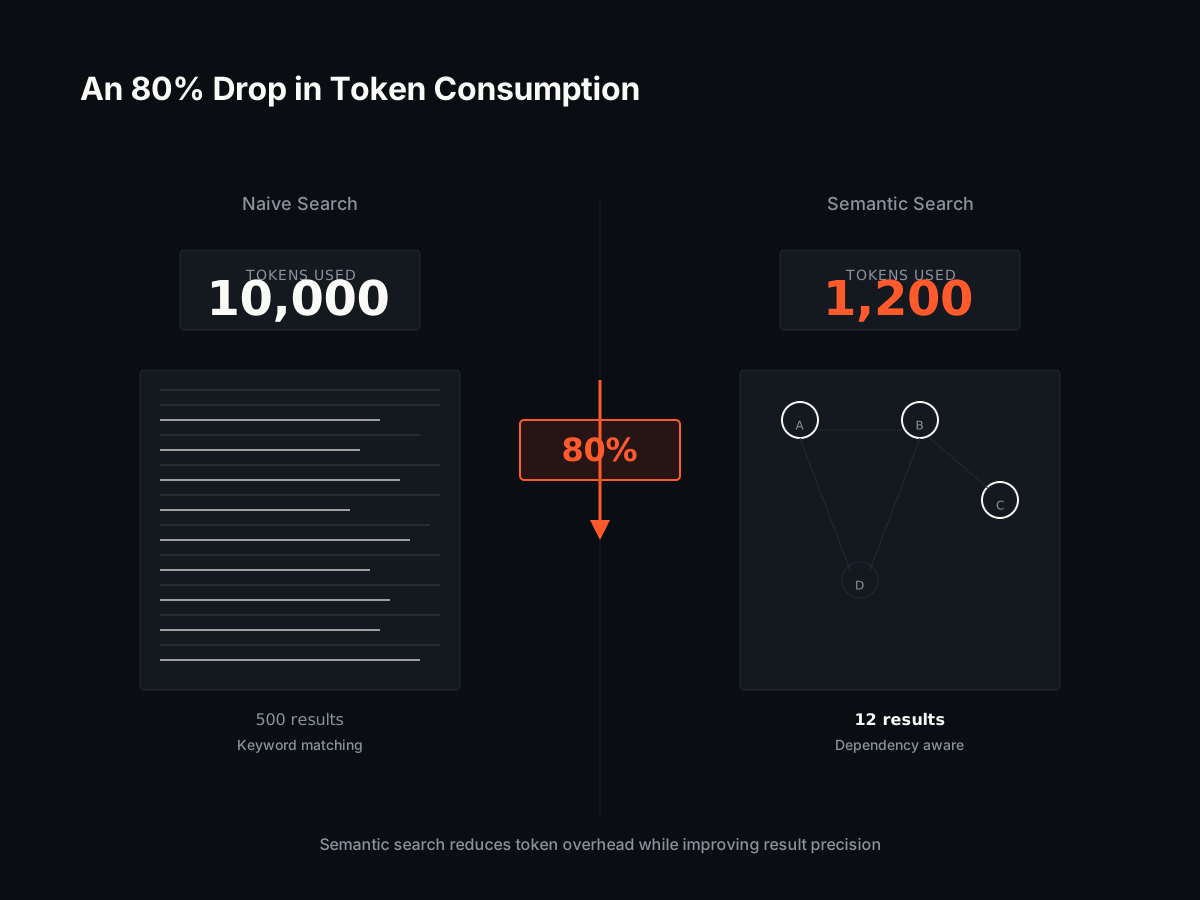
Here’s what happens without precise code context: your AI agent asks the codebase, “What functions call this database adapter?” It gets back every line of code that mentions the word “database.” The LLM sees 500 lines of noise, burns 10,000 tokens figuring out what’s relevant, and still gets it wrong 30% of the time.
With a code graph, the same query returns 12 files. The agent burns 1,200 tokens and nails it.
We measured this. Our reproducible benchmark shows that using Coograph to provide semantic context reduces token consumption by roughly 80% compared to naive file-based search. If your current bill is $30k/month on Claude or GPT-4 calls, a code graph drops it to $6k/month. That’s $24k/month in margin recovered—or $288k/year.
That math alone pays for four years of Coograph Pro in year one.
4x Fewer Tool Calls Per Task
Precision matters for speed, too. A poorly-informed AI agent makes spurious tool calls: it asks for the schema twice, re-reads the same file, re-runs the same test. With a code graph feeding only the relevant context, the agent makes 1 tool call where it previously made 4.
Fewer calls mean faster latency (your AI features feel snappier), higher success rates (less thrashing), and lower operational cost. An agent that used to take 18 seconds now completes the same task in 5 seconds, and your engineers see results immediately.
Accelerating Developer Velocity and Onboarding
If the hard savings don’t move you, the velocity argument should.
Focus on Shipping Product, Not Building Tooling
Your best engineers are not fungible. If your two most senior people spend six months building infrastructure, your product roadmap slides. Your hiring plan slips. Your Series B happens later or at a lower valuation.
Adopting code intelligence means your engineers stay focused on your company’s core business. A DevTools company builds AI-powered refactoring, not the graph engine underneath it. A security platform optimizes threat detection, not code parsing.
Slashing New Hire Ramp-Up Time
New engineers hate the first month. They’re lost in the codebase. They ask senior engineers 30 questions a day. Senior engineers spend half their time answering instead of building.
A code graph collapses this. A new hire can search “show me everywhere we handle API rate limits” and get the actual implementation path in seconds. They understand the architecture in days instead of weeks. They ship their first feature in week two instead of week four.
At a fully-loaded cost of $180k/year, every two-week acceleration per hire is worth $3.5k in recovered productivity. Hire 10 people a year: that’s $35k in ramp-up acceleration, just from having good code intelligence.
A Decision Framework: When to Build, When to Adopt
The honest answer: it depends. But not on what you think.
Build When It’s Your Core Business Differentiator
If you’re founding a company whose sole value prop is “we built a better dependency graph,” then yes, build it. You’ve chosen that as your moat.
For everyone else: code intelligence is leverage, not the product. It’s a foundation that makes your actual product faster, smarter, and more reliable. Foundations are usually better bought than built—especially when you can buy one with an MIT license and no vendor lock-in.
Adopt When You Need to Move Fast
You have one chance at your market window. You don’t have time to debug edge cases in your parser while your competitor ships AI-powered features. Adopting code intelligence—whether through Coograph or another tool—gets you to market with precise context, lower AI costs, and faster feature delivery.
The decision is not “build vs. buy intelligence systems in general.” It’s “should we spend six months and $250k to partially solve a problem that’s already solved, or should we focus on what only we can build?”
How Coograph De-risks the ‘Buy’ Decision
The reason teams hesitate on “buy” is usually vendor risk. What if this company pivots? What if they go out of business? What if they raise prices 10x once we’re locked in?
Coograph is built differently.
The Freedom of an MIT License
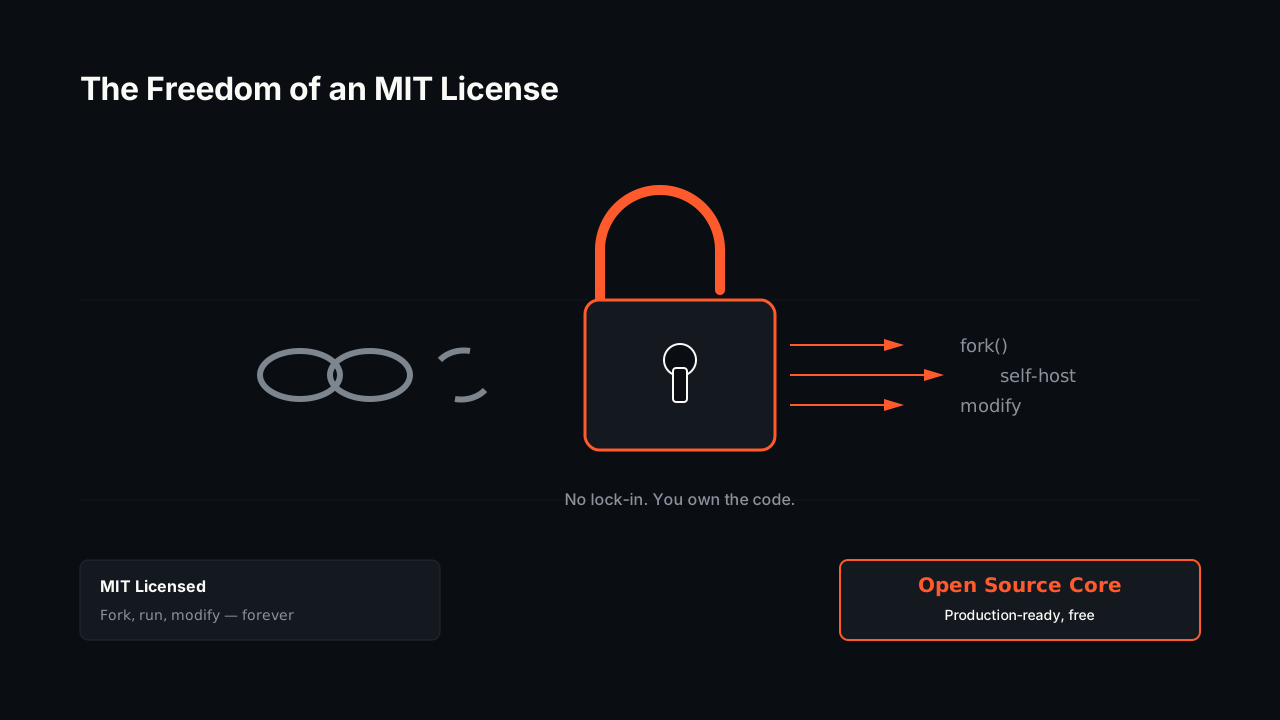
The entire codebase is open-source under an MIT license. You can fork it. You can run it on your own infrastructure. You can modify it for your needs. If Coograph as a company disappeared tomorrow, you still own the core system.
This is not a demo license. It’s not “open-core with the good stuff locked behind a paywall.” It’s a fully-functional code intelligence system you can use in production, for free, forever.
An Enterprise-Ready Path with Coograph Pro
Not every team wants to self-host and maintain. Some teams need SLAs, priority support, advanced security features, or a hosted platform they don’t have to operate.
That’s Coograph Pro. It’s the same underlying system, with enterprise support and managed hosting if you want it. You can start with the open-source version, evaluate it on your actual codebase, and upgrade to Pro when you’re confident it solves your problem. No surprise pivots. No lock-in.
The net effect: you get the risk profile of building (you own the code) with the speed and economics of buying (you don’t staff it).
What’s the real cost to build our own code intelligence?
For a production-ready system, expect 2–3 senior engineers to spend 6+ months. This translates to over $250,000 in salary and opportunity cost, plus ongoing maintenance forever. Every new language, framework, or edge case discovered adds weeks of engineering time.
How does Coograph directly lower our AI bills?
By creating a precise dependency graph, Coograph gives the AI agent only the relevant code context. This reduces LLM API token consumption by roughly 80%, directly cutting your monthly spend. If you’re spending $30k/month on Claude or GPT-4, a code graph can drop that to $6k/month.
Is the open-source version of Coograph sufficient for production?
Absolutely. The MIT-licensed version is powerful and used in production by teams managing millions of lines of code. We offer Coograph Pro for businesses that require enterprise-grade support, SLAs, hosted infrastructure, and advanced security features—but the open-source version works.
Does Coograph lock us into a specific AI model or provider?
No. Coograph is model-agnostic and works with Claude, OpenAI, Copilot, and any LLM-based tool. The open-source nature ensures you always have control over your stack and can swap components without being trapped by vendor decisions.
What’s the realistic timeline to see ROI?
Month one: reduce token consumption and see AI API costs drop. Month two–three: new engineers ramp faster and ship features sooner. Month four: you’ve recovered the cost of adoption and freed engineering capacity for product work. The math works within a quarter for most teams.
The build-vs-buy decision isn’t really about who builds better code graphs. It’s about where your time is worth more: solving a solved problem, or solving the problems only you can solve.
If you’re tired of the build argument, start by understanding what a code graph actually does. Read our code graph explainer, then get started with our open-source tools on your actual codebase. Spend an afternoon on it. See what your token consumption looks like. Then make the decision with real data instead of speculation.
Cut your AI coding bill 67–78%. Coograph is MIT-licensed and free forever. Pro is bespoke services.