AI Tool Sprawl: Your Devs Are Drowning in Inefficient Agents
Running five AI coding tools doesn't give you five times the leverage. It gives you five agents grepping the same repo, and a token bill that quietly compounds.
Count the AI coding tools your team pays for — an editor agent, a CLI agent, a CI review bot, whatever individual developers adopted on their own. Five is common, and every one of them rediscovers your codebase from zero on every single request. You are not buying five times the leverage. You are buying the same expensive file search five times over.
Here is the shape of the waste. An agent asked to change how authentication tokens are refreshed will typically grep for “auth”, pull in twenty-plus files that mention the word, stuff them into the context window, and then ask for more. Four of those files actually matter. The other sixteen you paid for.
The Hidden Cost of “More AI Tools is Better”
From Productivity Multiplier to Cost Center
Tool sprawl starts innocently. One team likes Cursor, another lives in Claude Code, a third wired up Aider in CI, and someone on platform wrote a review bot with the raw API.
Each purchase looked cheap in isolation. Together they form an unmanaged line item that grows with headcount and with model prices, and nobody owns the number.
Every Agent Re-learns Your Codebase from Scratch
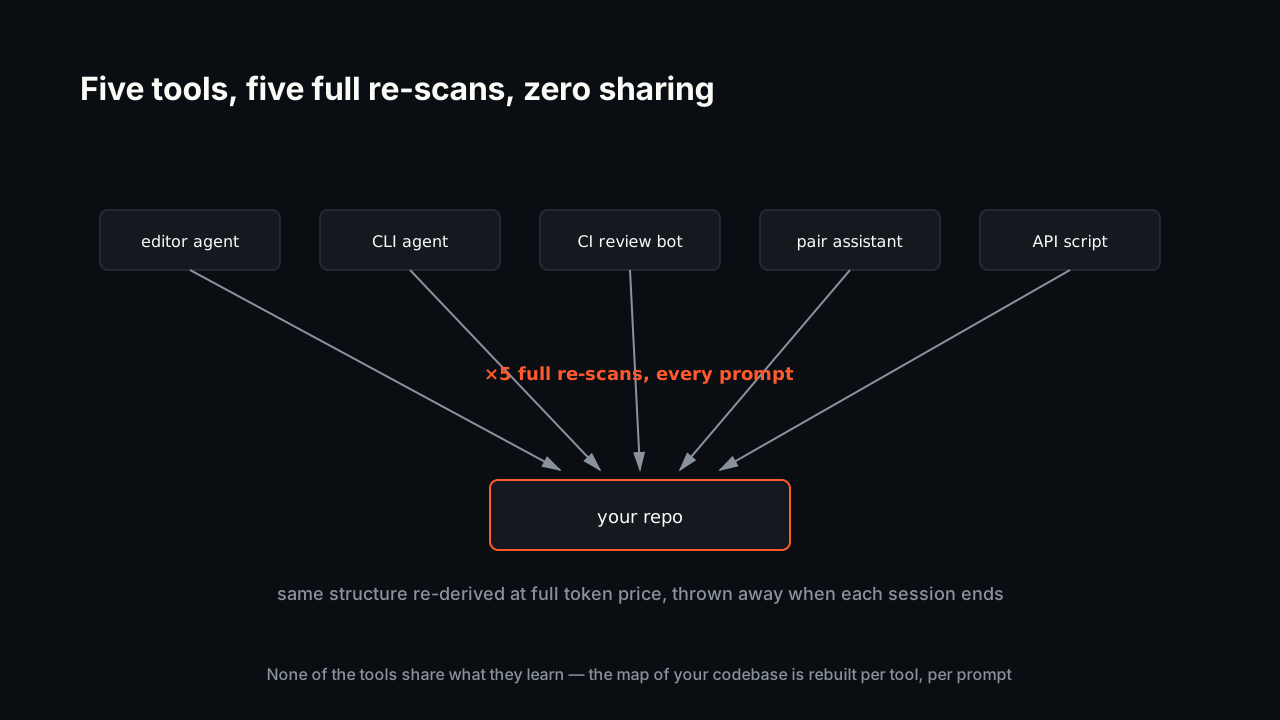
The deeper problem is not the subscriptions. It is that none of these tools share what they learn.
Your repo has a fixed structure: this module imports that one, this class implements that interface. That structure changes maybe a few dozen times a day. Yet every agent re-derives it on every prompt, at full token price, and throws it away when the session ends.
The Root Problem is Naive, Keyword-Based Context
Under the hood, most context retrieval is still keyword matching with better marketing. Grep, sometimes embeddings, occasionally an LLM guessing at filenames.
Keyword search has no concept of a dependency. It cannot tell you that the file you need does not contain the word “auth” anywhere, because it only calls refreshSession(). So the agent misses the right file, includes sixteen wrong ones, and burns another round trip figuring that out.
Quantifying the Waste: A Hypothetical 10-Engineer Team
Modeling Your True Token Overhead
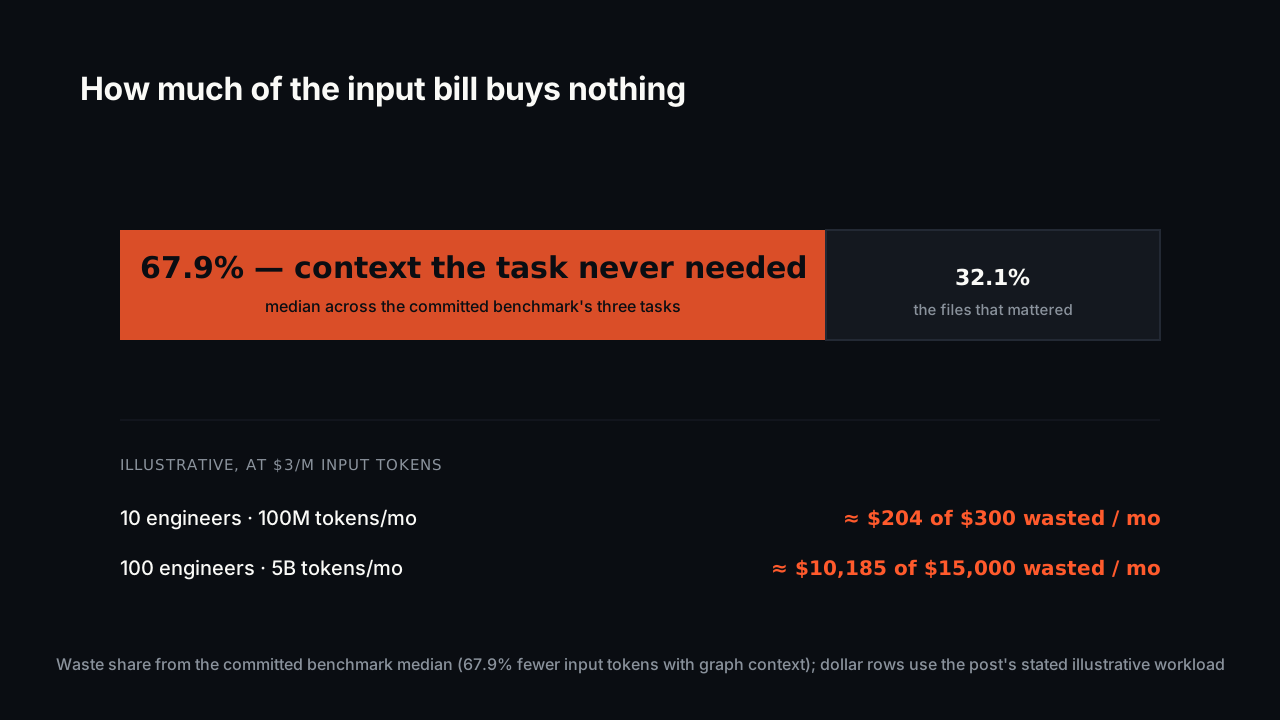
Suppose a 10-engineer team, each engineer’s agents consuming 10M input tokens per month. That is 100M input tokens across the team. At a blended $3 per million input tokens, you are at roughly $300 a month, or $3,600 a year, in input alone.
Our benchmark shows a median 67.9% reduction in input tokens when agents pull context from a code graph instead of searching blind. Applied to that team: about $204 a month back, roughly $2,445 a year.
That is real but not dramatic. The number gets interesting when you scale it. At 100 engineers running heavier agent workloads, say 50M input tokens each per month, you are at 5B tokens and $15,000 a month at the same rate. A 67.9% cut is over $10,000 a month.
Calculating the Cost of Redundant Tool Calls
The token bill is the part your CFO sees. The part your engineers feel is latency.
Our median result is 2.75x fewer tool calls to complete the same task. Concretely: a task that took eleven search-and-read round trips takes four. Every removed round trip is a wait your engineer sat through, watching a spinner, losing the thread of what they were doing.
Multiply seven removed waits by a few dozen agent tasks per engineer per week. The velocity number dwarfs the API savings, and it does not show up on any invoice.
Your Annual AI Spend is Quietly Inflated
The thing about inefficient context is that it compounds in the direction you do not want. More engineers, more agents per engineer, longer files, bigger repos. Every one of those makes the wasted fraction larger, not smaller.
Nobody notices, because the bill grows in step with headcount and headcount growth is supposed to cost money.
A Shared Brain: How a Code Graph Solves Tool Sprawl
One Source of Truth for Code Context
Coograph builds a single, queryable map of your entire codebase — files, symbols, imports, call relationships — and stores it as a plain SQLite file in your repo.
One artifact. Every agent reads it. Analysis happens once, incrementally, not once per prompt per tool.
From Keyword Search to Dependency Traversal
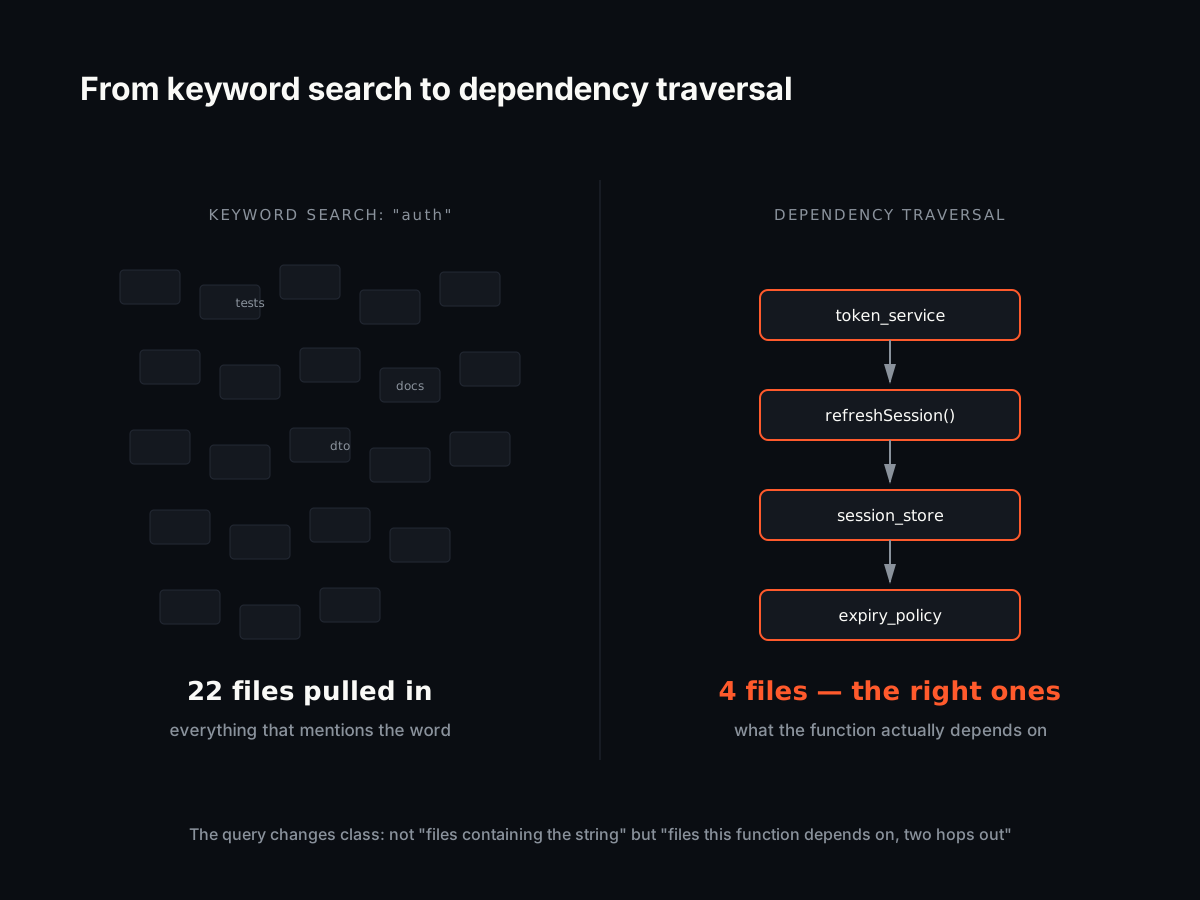
The query changes from “find files containing the string auth” to “give me the files that this function actually depends on, two hops out.”
That is a different class of question, and it returns a different class of answer: four files instead of twenty-two, and the four are correct. The agent stops guessing, which is why the tool-call count drops.
Making Every Agent an Expert on Your Repository
Because the graph lives in your repo rather than inside a vendor’s product, the same context serves Cursor, Claude Code, Aider, your CI review bot, and the shell script someone wrote last quarter.
Your worst-informed agent gets the same map as your best-informed one. That is the actual fix for sprawl: not consolidating tools, but consolidating what they know.
The Build-vs-Buy Calculation for Code Intelligence
The True Cost of Building an In-House Solution
Some teams try to build this. It reads like a two-week project and turns into a multi-engineer-year one.
You need per-language parsing, incremental updates on file change, symbol resolution across module boundaries, monorepo handling, and a query layer fast enough to sit in an interactive loop. Then you maintain it forever, across every language your company adds. Unless code intelligence is your product, this is a very expensive distraction.
The Lock-in Risk of Closed Vendor Platforms
The alternative failure mode is letting one vendor own your context layer. Their index, their retrieval, their supported agents.
It works until you want to switch models, add a tool they do not support, or run something on-prem. Then you discover that the most valuable asset — the map of your own code — was never yours.
The Open-Source Advantage: Control and Extensibility
Coograph is MIT-licensed and self-hostable. The graph is a SQLite file you own, in a schema you can query directly, on infrastructure you control.
Teams that want hands-on help — bespoke integration, custom parsers for in-house languages, benchmarking on their own workloads — can pay for Coograph Pro, but the core stays open with no gated features. If we disappeared tomorrow, your graph would still work.
Unify Your AI Tooling and Cut Spend This Week
Integrating With Your Existing Agent Fleet
This is not a migration. Coograph works with eight popular agents — Claude Code, Cursor, VS Code Copilot, Windsurf, Codex CLI, OpenCode, Aider, Cline — and integration is minutes: clone it as a sibling directory, run /coograph-init from your tool, and your agents query the graph over MCP instead of grepping.
You keep the tools you already pay for. They just stop wasting your money.
Verifying Performance on Our Public Benchmark
Do not take the 67.9% on faith. Our benchmark is open and reproducible — three fixed tasks against two committed fixture repos, tokens counted with a real tokenizer rather than a character-count estimate. It is a median across those tasks, not a universal guarantee.
Run it on your own repo. If the numbers on your codebase are worse than ours, that is useful information too.
How is this different from GitHub Copilot Enterprise’s code search?
Copilot’s context features only work inside GitHub and Microsoft’s tooling. Coograph is open-source and vendor-neutral, and works across eight popular agents. You own the index rather than renting access to it.
Is this a major engineering project to implement?
No. Coograph produces a self-contained SQLite file (.code-graph/graph.db) and exposes it over MCP. Setup is cloning the repo as a sibling directory and running /coograph-init from your agent — minutes, not a project. A git hook keeps the graph current on each commit.
What is the real ROI of reducing tokens and API calls?
Two things: a lower monthly LLM bill and faster agent responses. Median 67.9% fewer input tokens and 2.75x fewer tool calls. At 10 engineers the dollar savings are modest; at 100 the latency savings alone justify it.
Does Coograph replace my team’s existing AI coding tools?
No. It sits underneath them as a shared context layer, making Cursor, Aider, Claude Code and anything else you run more accurate and cheaper per task. You are not consolidating vendors, you are consolidating what they know.
What happens on a large monorepo?
The graph is built incrementally, so the expensive pass happens once and subsequent updates track file changes. Very large repos are where the token savings are biggest, since keyword search degrades fastest there.
Pick your noisiest repo, index it, and point one agent at the graph instead of grep — our getting started guide gets you there in a few minutes, and if you want hands-on integration help across a large monorepo, Coograph Pro is the services arm for that. Then compare your token counts on the same task before and after, and decide with your own numbers rather than ours.
削減你的 AI 編程帳單 67–78%。Coograph 採用 MIT 授權、永久免費。Pro 提供客製服務。